

there have to be minds happier than ours, but we have no idea how to get there.
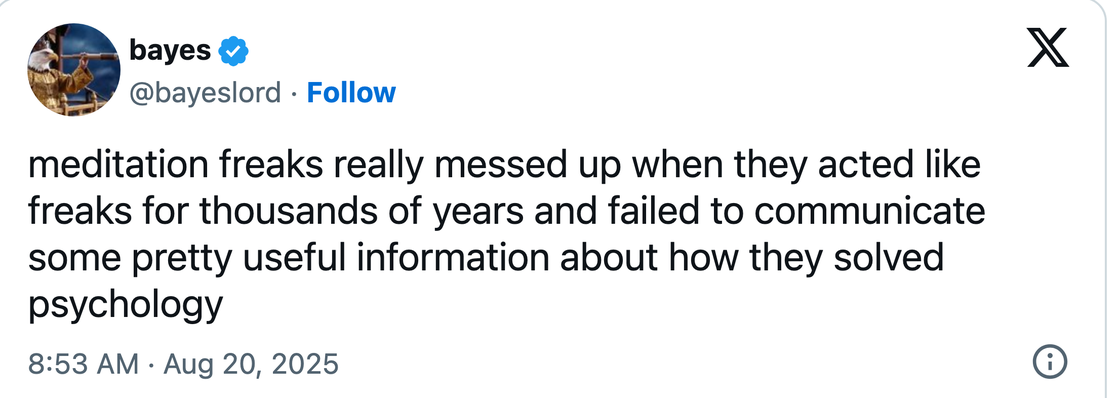
i see three major blind spots in modern society. religions have traditionally offered answers to all three, but in my view have failed to update those answers for the past few thousand years.
- how to be happy? how to flourish more and suffer less?
- how to act morally? what's right and what's wrong?
- where to find meaning and purpose? what makes a life worth living?
here i will present ideas to lead you to better states of mind which tie into a moral framework. they come from a combination of meditation practice, discussions with Buddhist monks and meditation teachers, reading on Buddhism, Sam Harris (especially on free will and morality), and various other authors and teachers.
this post is my attempt to simplify these ideas, strip the religious bias, and present a framework on flourishing and morality.
chapter 1: from suffering to flourishing
our whole life is just a sequence of moments, experienced through our minds. there is never anything outside these moments. every memory of the past and every thought about the future happens now.
we also know that material things alone are not the key to happiness. what matters is how we experience and relate to things.
so if happiness is to be found, it must depend on the quality of the mind. and since life is only ever experienced now, it must be possible to find it in the present moment.
how and where we place our attention in each moment shapes the moment, and so it shapes the quality of our lives. learning to direct our attention in a meaningful way in each moment is therefore the most important thing we can learn.
this is what meditation is.
note that it requires a lot of practice, and that it is not a linear path. you will go back and forth between the steps.
observe the experience: 1 to 7
- stop, and become curious about whatever is happening. listen to a sound, feel a sensation in your body, or notice a thought.
- notice that all you experience (and what you will ever experience) is just sensations (sounds, pressure, sight, etc.) and thoughts. when an emotion appears, notice the bodily sensations and thoughts that make it up.
- notice two ways of experiencing thought. you can recognise a thought without getting lost in it, or you can be completely immersed in it, living it. thoughts always appear in some form, such as words, sounds or images.
- notice that no effort is needed for experience to happen. even thoughts appear and disappear on their own. watch for the next thought. did you know what it would be before it appeared? this is what i mean when i say you do not choose them. even the intention to think about something appears in the same way.
- notice how you are not actually seeing the world as it is. you are seeing a world filtered through your thoughts. notice the difference between hearing a sound and thinking “that’s annoying.”
- notice the difference between a sensation or thought and your judgement of it as good or bad. how you relate to it changes how it feels.
- notice that every sensation and thought changes and eventually passes.
these are realisations that come with practising meditation, and can be directly observed. they are the foundation for the next steps.
direct your awareness: 8, 9
- notice that, from the point of view of experience, there is no centre. you are not in your head; rather, your head is in your experience. look for the one who seems to be watching. even a sensation behind your eyes is part of the experience.
- in more and more moments, stop being lost in thought. notice things as they are. choose where you actually want to place your attention. choosing still happens. it does not require a separate chooser behind the experience.
i see these as the tools we need to end suffering and to flourish. when you get caught in a reaction, you can stop and notice the thoughts and sensations instead of being completely lost in them. and you can choose to arrive. pay attention to what is already here, rather than waiting for the next thing to make the moment enough. the next two steps are about practising these two things.
for easing suffering: 10
- look more closely at the unpleasantness. notice that the negative emotion is made of thoughts and unpleasant sensations.
when you curiously observe the thought, it will eventually pass. and what's left is the sensation in the body, but now without the same psychological grip on you.
when you observe and embrace an emotion, you can watch it unfold like a movie. no good movie has only good scenes. there can be beauty in the unpleasantness.
the goal here is not to get rid of the feelings, but to feel them fully, embrace them, and notice them pass.
for flourishing: 11
- look more closely, and notice that whatever
you find is already enough. embrace the moment with curiosity and you might find that any ordinary moment can already be perfect.
like this we can stop attaching our happiness to some future thing, but rather access it already here regardless of the contents of the moment.
this does not mean becoming passive. you should still change, build, love, fight for what matters, and move toward the things you want in life. but happiness and peace do not have to wait for some future where you have figured everything out. you can act with more care, and with more freedom from needing the outcome to decide whether you can be okay. for the quality of your life, your mind matters much more than the contents of your life.
i think most of our problems could be solved with these three steps:
1. stop
2. pay attention
3. repeat
when you get caught in a reaction, stop and look more closely. what are the sensations and thoughts, and what is the story you are adding to them? notice the difference between what is happening and your idea of what should be happening.
and choose to arrive. instead of waiting for something to change before you can be okay, pay attention to what is already here. you can still act and change things, but the moment does not have to wait. when you get lost again, repeat.
chapter 2: on morality
we need to start the conversation on morality from two concepts.
1. the fact of consciousness
the only thing we can ever know for sure is that there is something it is like to be us, an idea i take from Thomas Nagel. everything else can, at least in principle, be doubted.
this gives us a clue as to why we should care about the wellbeing of conscious beings. conscious beings are the only things we know for sure can experience anything at all, and therefore the only things for which things can go well or badly.
2. the illusion of free will
we can look at this in two ways.
first, the objective argument. if we do not believe in supernatural things, then who we are is shaped by only our genes and our environment. we choose neither. every action we ever take is just the result of everything that came before it. whether these causes are deterministic or random does not matter for free will. randomness is not something we control either.
second, the subjective argument. you can observe your own mind and notice that you never choose a thought before it appears. like everything else, thoughts simply pop into awareness, based on everything that came before.
the whole idea of choosing a thought is strange when looked at closely. the argument is Sam Harris's: in order to choose your thought, you would already have had to think it before you thought it. this also applies to actions.
this beautifully aligns with the earlier realisation that there is no centre to the experience. no one is in charge of the mind. it is just a flow of experience. choosing still happens. the question is if we are the ultimate authors of those choices.
what follows
if we are not the authors of our own minds, then it becomes difficult to blame people, in some ultimate sense, for having the minds they have. and the same applies to actions.
this does not mean that actions are not real or that they do not have consequences. harmful actions should still be stopped. people can still be held responsible. consequences still matter because they affect what happens next.
but it does mean that we should try not to hate people for their actions. we can hate the action and its consequences without hating the person behind it. this opens the door to compassion towards all beings, including those who do things we strongly oppose.
this, combined with the fact of consciousness, leads me to the framework Sam Harris argues for in The Moral Landscape. i find the strongest candidate for grounding morality to be the wellbeing of conscious beings.
in this framework, a moral act is one that moves conscious beings away from suffering and towards flourishing.
chapter 3: on meaning
like we discussed in chapter 1, we can find happiness and peace already here, in this moment, whatever its contents. that is the first level of wellbeing.
the second level is what you do with the contents of your life. and when you reject free will, you might ask yourself, why even do anything if i don't get credit for any of it?
first, the world is full of beauty and love and great things, and they are there to be explored. you have a limited number of moments to do it in, so go enjoy them. what you find beautiful and interesting is for you to figure out, but you can surely find it if you look.
second, the world is also full of suffering to reduce and flourishing to increase. the framework from chapter 2, on increasing the wellbeing of beings, seems like a great clue about what is worth doing in life.
the key here is to not tie the outcome of whatever you do to your happiness. and in the worst case, just return to the first level of wellbeing, which is always available.
there have to be minds happier than ours. and these are the ideas i have found helpful getting there. i hope they are useful to you too.